Refrigerator Repair
Viking built-in runs all afternoon and never settles
Written by Keiko Mabuchi Service technician — cooktops and ventilation · 11 years in the trade
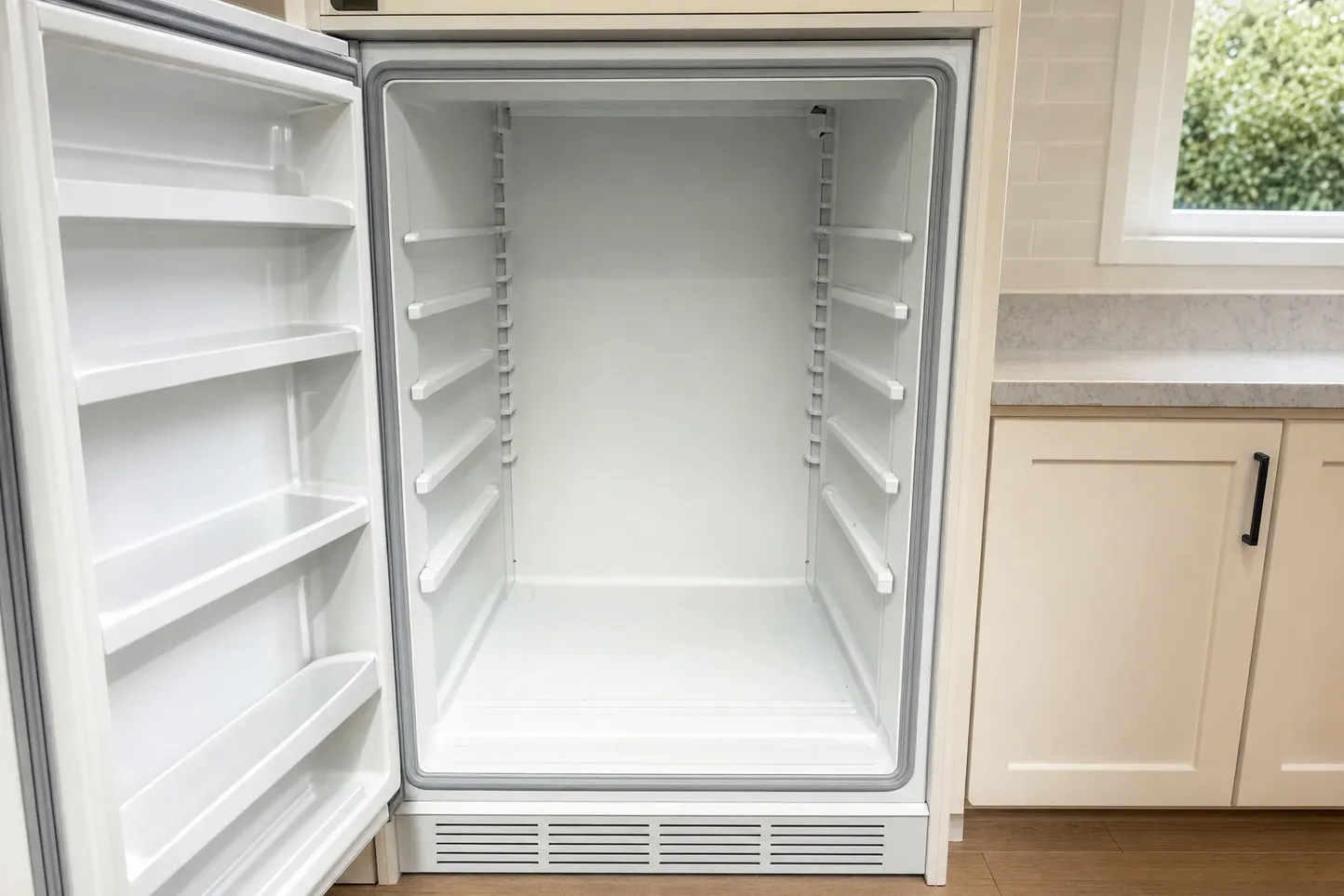
“It runs all afternoon and never settles” is the most common way people describe a built-in Viking refrigerator that is in trouble, and it is a genuinely useful description — much more useful than a temperature reading. A unit that runs constantly is not failing to make cold. It is making cold and failing to get rid of the heat it took out, or failing to move the cold it made to where the thermometer is.
That distinction matters because one of those is a cleaning job and a fan motor, and the other is a sealed system. In Bel-Air and the canyons we see the first far more often than the second, and it gets quoted as the second more often than it should.
What “never settles” actually means
A refrigerator is a heat pump. The compressor raises the pressure of the refrigerant, the condenser coil dumps that heat into the room, and the evaporator inside the cabinet absorbs heat from the food. If the condenser cannot get rid of heat fast enough — because the coil is insulated with dust, or the fan pushing air across it has slowed — the whole loop runs hotter and less efficiently, and the compressor simply never reaches the point where it can stop.
Two things follow, and both are diagnostic. First, the unit gets slowly worse over years rather than failing overnight. Second, it is much worse in the afternoon, because ambient temperature is part of the equation and a canyon kitchen at four o’clock is not the same kitchen it was at nine.
If your unit runs continuously in August and cycles normally in February, that is airflow. A failing sealed system does not care what month it is.
Start with the condenser, not the compressor
On a built-in the condenser is behind a grille — usually at the top of the cabinet on a column, sometimes at the base — and it is the single most neglected part of an expensive kitchen. It draws room air across an aluminium fin block, and room air in Los Angeles carries a great deal: cooking grease that turns dust into felt, drywall dust from any work in the house, dog hair, and on the coast side a fine salt film that holds all of the above onto the fins.
What that felt does is act as insulation, exactly the opposite of what a condenser needs. We have pulled mats off condensers thick enough to peel away in one piece, on units their owners were being told needed a new compressor.
The condenser fan is the other half. It is a small motor running in the hottest, dirtiest part of the appliance, and when its bearings dry out it slows before it stops. A fan turning at half speed still looks like it is working if you glance at it, which is why this one gets measured rather than eyeballed.
The three airflow faults that look worse than they are
Beyond the condenser, three internal faults produce alarming symptoms and modest repairs.
- An iced evaporator. The evaporator sits behind a panel in the freezer section. When a defrost heater or its sensor fails open, frost builds until it blocks the air path completely. The freezer stays cold — it is sitting next to a block of ice — while the fresh-food side drifts warm because no air is reaching it.
- A stalled evaporator fan. Same result, different cause: cold is being made and not distributed. Often audible as a ticking or a rattle before it stops entirely.
- A door gasket that has gone hard. A gasket that no longer sits flush lets warm room air in continuously, so the unit runs continuously. Common on the coast, and easy to test: shut a strip of paper in the door and see if it pulls out without resistance. Do that at four or five points along each side.
None of those three is a sealed-system repair, and all three present as “it runs constantly and it is warm inside”.
What you can check yourself in ten minutes
- Pull the grille and put a torch behind the condenser. Fins that pass no light are wearing the felt described above, and that alone accounts for the afternoon.
- Put a hand near the grille while it is running. You should feel warm air being moved, not just warmth sitting there.
- Do the paper test on both door gaskets, top to bottom.
- Look for water under the crisper drawers. That is a blocked defrost drain, and it is worth mentioning because it often travels with a defrost fault rather than being a separate problem.
- Leave a thermometer sitting in a tumbler of water halfway up the compartment and come back to it four hours later. Air measured through an open door tells you almost nothing; the water is what the food is living in.
Write down what you find and what time of day it was. On a phone call, “runs constantly from about two in the afternoon, condenser was thick with dust, both gaskets pass the paper test” is worth more than any amount of description of the noise.
When it really is the sealed system
Sometimes it is. The signs are different: both compartments drifting warm together rather than one; a compressor that runs but the condenser never gets properly hot; frost patterning on only part of the evaporator; or a unit that has been cleaned, has good airflow, sound gaskets and a working fan, and still cannot hold temperature.
That is a gauges-and-recovery job, and it is the point at which the age and the model of the cabinet start to matter to the decision. It is also the point at which you want somebody to show you the readings rather than the invoice. Ask what the suction and discharge pressures were and what the ambient was when they were taken — a straight answer to that question is the difference between a diagnosis and a guess.
If you would rather someone else did the reading, the visit and the diagnosis are a flat $89, credited against the repair if you go ahead.
Loose ends
How long should a built-in refrigerator run for?
On a hot Los Angeles afternoon, long. Sixty to eighty per cent of the hour is not unusual for a built-in in a warm kitchen, and a unit that has just been loaded or left open will run flat out for a while. What is not normal is running continuously and still drifting warm, or running continuously for days once the weather has cooled off.
Can I clean the condenser myself?
The accessible part of it, yes. The grille at the top or the base comes off with a couple of screws on most built-ins, and a soft brush plus a vacuum crevice tool gets the worst of the felt off the fins. Do not push a brush deep into the coil or lean on the aluminium fins, and unplug it first — the condenser fan can start without warning.
Is a warm fresh-food side with a cold freezer a sealed-system problem?
Rarely. That split almost always means air is not moving from the freezer evaporator into the fresh-food compartment: an iced evaporator, a failed defrost heater or sensor, or a stalled evaporator fan. A genuine refrigerant loss usually shows up as both compartments drifting warm together.