Outdoor Grill Repair · Models
Viking Professional 5 Series outdoor grill: VQGI and VQGFS
If an element glows steadily and silently when a knob is pressed in, you have a 5 Series: Viking states plainly that this ignition does not spark. Cut the power and it cannot glow, so the grill has to be match-lit with the rod kept in the drip tray. Read the number off that same tray to Viking Repair Experts Los Angeles on (213) 600-7131.
- Series
- Viking Professional 5 Series Outdoor Gas Grills
- Model prefixes
- VQGI5301 · VQGI5361 · VQGI5421 · VQGI5541 · VQGFS5301 · VQGFS5361 · VQGFS5421 · VQGFS5541
- Ignition
- Hot surface igniter. It glows while a knob is held in and never sparks, and it needs a 120-volt GFI outlet to glow. Without power the burners are match-lit instead, with the rod in the drip tray.
- Gas
- Natural gas or propane, set at the factory. Regulator and manifold orifices are both tuned to the fuel named on the plate.
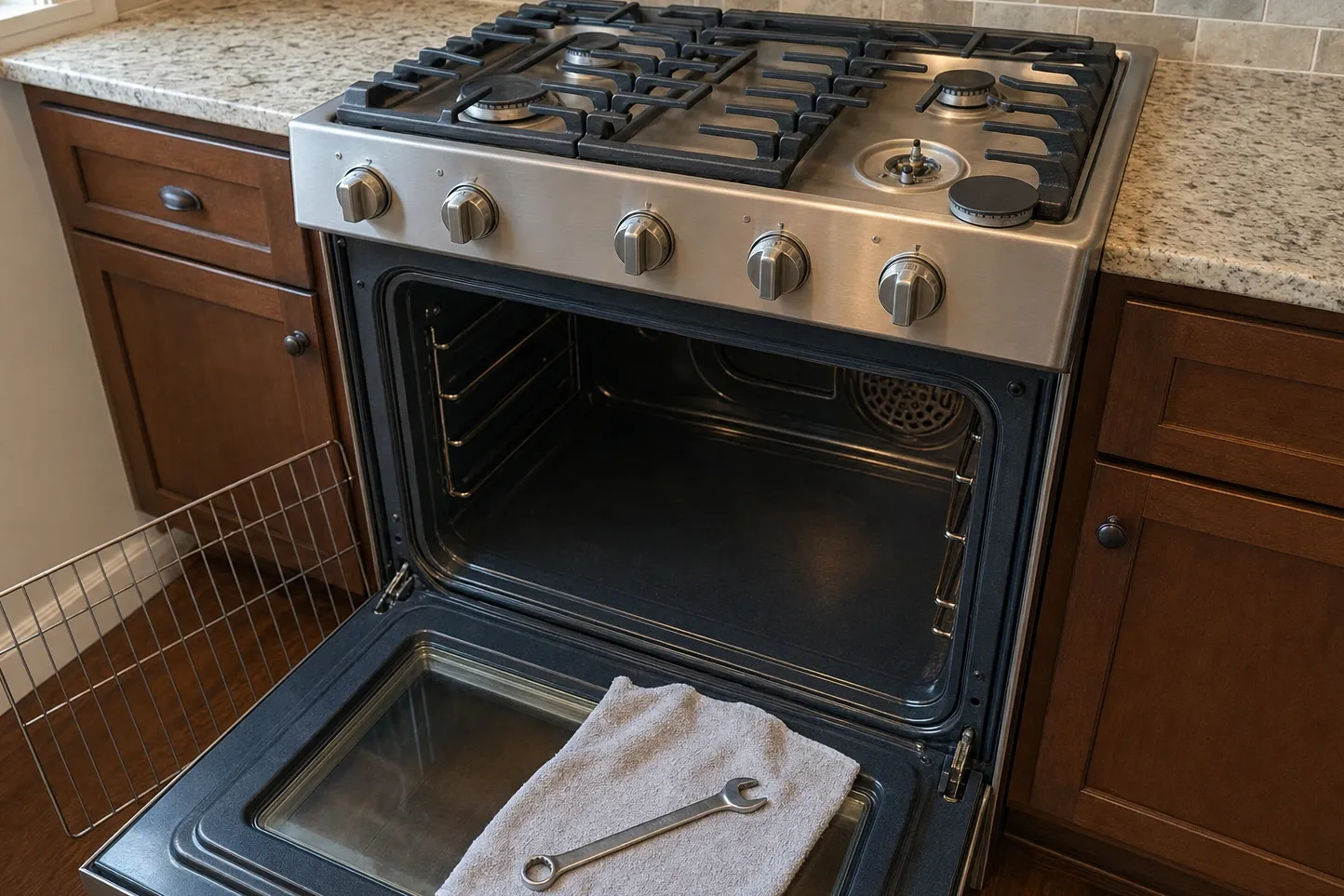
Where the rating plate is on this one
- Underneath the drip tray. Pull the tray out of the cabinet and turn it over — this is the usual position and the one people walk past.
- On the heat shield behind the front panel. Viking names both positions, and a grill may carry its plate in either of them.
What comes in on this generation
- An igniter that no longer glows, on a grill whose owner has been match-lighting it for a season without realising anything had failed.
- Brass burners with the port line closed along one end, which reads as a burner that lights but will not carry heat to the back.
- A rotisserie burner that lights and then goes out the moment the knob is released, because the thermocouple has not been given its time.
- Briquette trays burnt through, and ceramic briquettes that no longer burn off what lands on them.
- Low heat on every burner at once, which is a supply question rather than a burner question.
What the series actually names
Viking’s 5 Series outdoor grills come in two families that share almost everything: VQGI is the built-in, VQGFS the freestanding cart. The 5 that follows the letters is the series, and the next two digits are the width — 30, 36, 42 or 54 inches. A VQGI5361 is a 36-inch grill, not a 5,361 of anything, and burner length, cut-out and jacket size all follow from that pair.
Inside are up to three kinds of burner, worth telling apart before anything is diagnosed: main brass burners under the briquette trays, a ProSear infrared burner for searing, and a rotisserie infrared burner spanning the back wall on its own run.
Why the power matters on this generation
The 5 Series ignition is not a spark system. Viking’s troubleshooting says the igniters glow while a knob is pushed in, and it opens by asking you to confirm the grill has electricity. One left unplugged, or behind a GFI that tripped in a storm, presents exactly like a gas fault.
What it does not do is die with the outlet. Every main burner but the right-most has its own manual lighting tube, and a lighting rod sits in the drip tray for the rest. So the test is the glow against the click, never whether the grill lights with the power off.
Lighting a main brass or ProSear burner means holding the knob in five to seven seconds while the igniter warms, then turning to LITE. The rotisserie burner has its own, longer sequence.
What the season does to one on this side of town
A grill standing in marine air all year loses port area rather than components. Viking asks for burners, venturis, orifices and valves to be checked for obstructions at the start of each season, and on the coast that is the difference between keeping a flame line and quietly losing a third of it. It is also the right first move on one that has sat through ash or heat.
Wind is the other local factor, and not a fault. Viking notes that wind across the hood gap from behind can prevent hot gases exhausting, hurt performance and make the control panel dangerously hot. Facing open water, siting is worth as much as servicing.
Asked on the phone
How do I tell a 5 Series from the older grills without the plate?
Press a knob in and watch, in shade if you can. A 5 Series igniter glows steadily and makes no sound at all. The earlier grills click instead: a T-Series has an ignition button beside each knob and a battery behind the panel, an E-Series has lights in the canopy and no buttons. Power settles nothing, since every one of them can be match-lit.
Can a 5 Series grill be swapped for the same size without rebuilding the island?
Sometimes, and the planning table is what decides it rather than the badge on the front. A 30-inch grill wants a 29-inch opening without a jacket and a 36-inch opening with one, so a change of jacket alone moves the hole. Send the opening you have and the model you want and it can be checked on paper.
What does the ProSear burner need?
Running on high with the hood open after each cook, to burn off what landed on it. Viking gives two figures for that in one manual — five minutes in the care section and fifteen in the ProSear section — so treat five as the minimum. Every three to six months it comes out for the venturi and orifice to be checked.
Written by Keiko Mabuchi Role: Service technician — cooktops and ventilation In the trade: 11 years
Somebody who has had this generation apart
Give us the number off the plate and what the igniter does when you press a knob. $89 covers the visit and the diagnosis, and comes off the repair.
$89 for the visit and the diagnosis, credited against the repair. Work carried out 8:00 am – 8:00 pm, seven days.